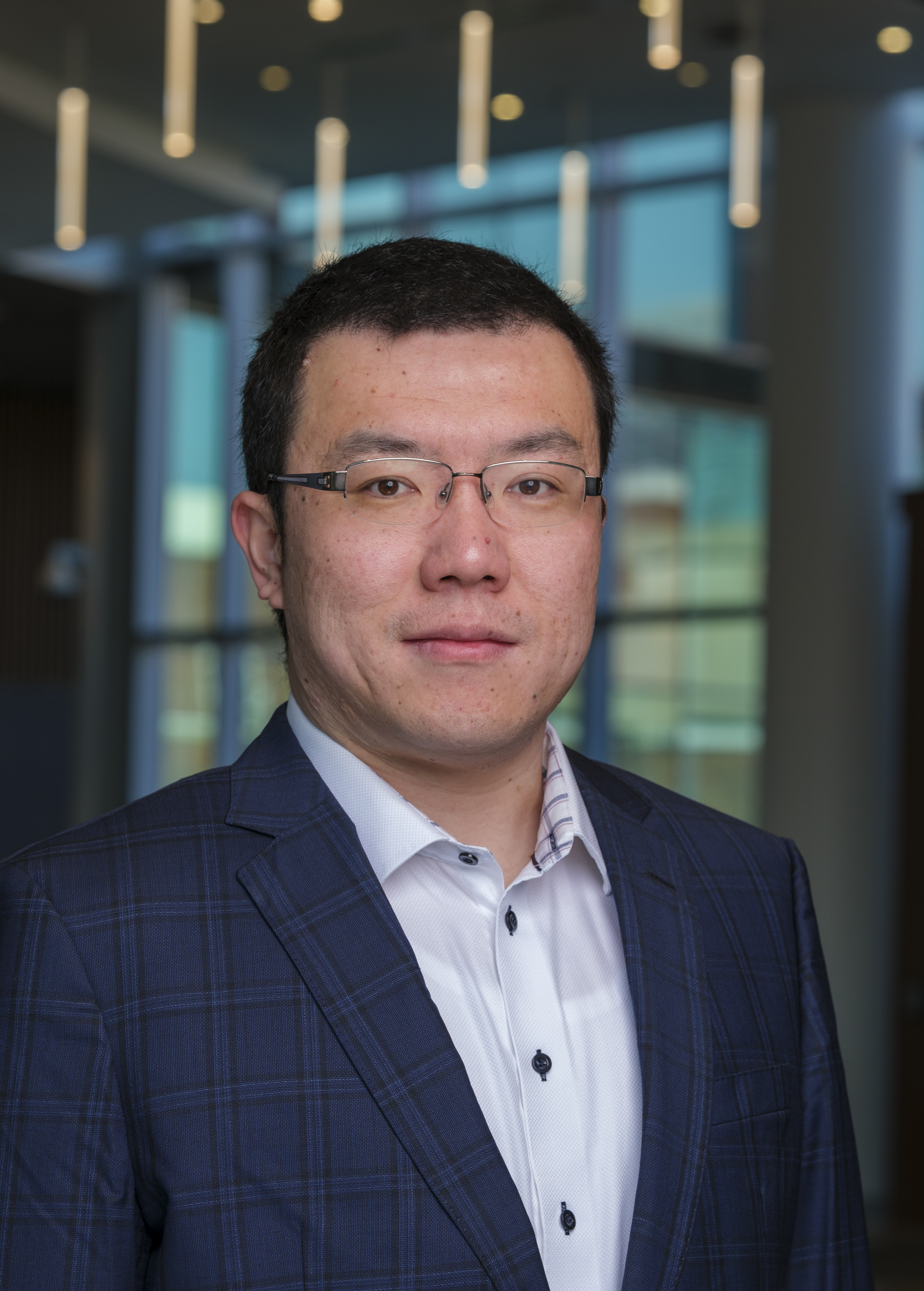
Ang Li
Assistant Professor, ECE, University of Maryland College Park
I am currently a tenure-track assistant professor in the Department of Electrical and Computer Engineering at University of Maryland College Park. Before joining UMD, I was a Research Associate in Qualcomm AI Research. I obtained Ph.D. from Duke University under the supervision of Professor Yiran Chen. My research interests lie in the intersection of machine learning and edge computing, with a focus on building large-scale networked and trustworthy intelligent systems to solve practical problems in a collaborative, scalable, secure, and ubiquitous manner.
Openings: I’m looking for highly motivated Ph.D., master students, and research interns to join my group. If you are interested, please send an email to angliece@umd.edu with your CV and transcripts attached.
Openings: I'm looking for highly motivated Ph.D., master students, and research interns to join my group. If you are interested, please send an email to angliece@umd.edu with your CV and transcripts attached.
News
- 2026-08-07 I’m honored to receive the NSF CAREER Award! Deeply grateful to my students, collaborators, mentors, and colleagues whose support has made this possible.
- 2026-06-18 We have two papers accepted by ECCV 2026! Congratulations to Bowei, Shwai, and our collaborators.
- 2026-05-01 We have three papers (2 main track, 1 position paper) that have been accepted by ICML 2026! Congratulations to Shwai, Guoheng, Ziyao, and our collaborators.
- 2026-04-06 We have three papers (1 main conference, 2 findings) that have been accepted by ACL 2026! Congratulations to Shwai, Guoheng, and our collaborators.
- 2026-02-21 Our paper “UniCompress: Token Compression for Unified Vision–Language Understanding and Generation” has been accepted by CVPR 2026! Congratulations to Ziyao.
- 2026-01-24 Our paper “Capacity-Aware Inference: Mitigating the Straggler Effect in Mixture of Experts” has been accepted by ICLR 2026! Congratulations to Shwai.
- 2026-01-23 I am deeply honored for receiving 2026 CPAL Rising Stars Award! Many thanks for the acknowledgment.
- 2025-06-07 I am very thrilled to share that two Ph.D. students (Guoheng Sun and Shwai He) in our group have been awarded Qualcomm Innovation Fellowship, and they are one of only 17 teams receiving the 2025 award!
- 2025-05-01 Our paper “Speculate, then Collaborate: Fusing Knowledge of Language Models during Decoding” has been accepted by ICML 2025!
- 2025-04-07 Our paper “EdgeLoRA: An Efficient Multi-Tenant LLM Serving System on Edge Devices” has been accepted by 2025 ACM MobiSys!
- 2025-01-22 Our paper “Towards Counterfactual Fairness through Auxiliary Variables” has been accepted by ICLR 2025!
- 2025-01-15 I have received the Cisco Research Award! I deeply appreciate Cisco’s generous support, which will empower our ongoing research and innovation.
- 2025-01-15 I have been invited to serve as an Associate Editor of IEEE Transactions on Neural Networks and Learning Systems (TNNLS).
- 2024-10-16 Our paper “Moderator: Moderating Text-to-Image Diffusion Models through Fine-grained Context-based Policies” received Distinguished Paper Award at ACM CCS'24. Congrats to all the co-authors!
- 2024-09-26 We have three papers accepted by NeurIPS 2024 (2 Main Conference + 1 Dataset & Benchmark Track)! Congratulations to my students and collaborators.
- 2024-08-26 Invited to serve as area chair for ICLR 2025.
- 2024-02-26 Our research paper titled “MAPSeg: Unified Unsupervised Domain Adaptation for Heterogeneous Medical Image Segmentation Based on 3D Masked Autoencoding and Pseudo-Labeling” has been accepted by CVPR 2024.
- 2024-02-24 Our research paper titled “SiDA: Sparsity-Inspired Data-Aware Serving for Efficient and Scalable Large Mixture-of-Experts Models” has been accepted by MLSys 2024.
- 2024-01-22 Our research paper titled “FedHyper: A Universal and Robust Learning Rate Scheduler for Federated Learning with Hypergradient Descent” and “Enhancing One-Shot Federated Learning Through Data and Ensemble Co-Boosting” have been accepted by ICLR 2024.
- 2023-10-07 Our research paper titled “FedNAR: Federated Optimization with Normalized Annealing Regularization” has been accepted by NeurIPS 2023.
Research Vision
Efficient, scalable, and privacy-preserving distributed learning across heterogeneous edge devices.
Our work on federated learning addresses key challenges including device heterogeneity (Hermes, MobiCom'21; FedMask, SenSys'21), communication efficiency (LotteryFL, SEC'21), asynchronous training (FedSEA, SenSys'22), client sampling (Fed-CBS, ICML'23), and optimization (FedNAR, NeurIPS'23; FedHyper, ICLR'24). We also explore federated fine-tuning of large language models (Flora, NeurIPS'24; EdgeLoRA, MobiSys'25).
Building large-scale intelligent systems that are robust, efficient, and secure for real-world deployment.
We develop techniques for efficient inference and serving of large models, including Mixture-of-Experts systems (SiDA, MLSys'24), model compression, and edge deployment. Our research also covers trustworthy AI including privacy-preserving representation learning (TIPRDC, KDD'20), defense against model poisoning (FL-WBC, NeurIPS'21), and fairness in AI systems (ICLR'25).
Applying AI innovations to solve real-world challenges in healthcare, EDA, and beyond.
We leverage machine learning to address critical challenges in healthcare (NeuroSymAD for Alzheimer's diagnosis, MedOrch for medical reasoning, Fair Diagnosis), electronic design automation (SymRTLO, NeurIPS'24; VeriReason; MCP4EDA; AutoEDA), and autonomous driving (AutoFed, MobiCom'23).
Awards & Honors
- NSF CAREER Award (2026)
- CPAL Rising Stars Award (2026)
- Qualcomm Innovation Fellowship (Students: Guoheng Sun, Shwai He) (2025)
- Cisco Research Award (2025, 2026)
- ACM CCS Distinguished Paper Award (2024)
- IEEE TCCPS Outstanding Ph.D. Dissertation Award (2023)
- Duke ECE Outstanding Ph.D. Dissertation Award (2023)
- ACM KDD Best Student Paper Award (2020)
Publications
Loading publications...
Invited Talks
- Federating Foundation Models in the Wild: From Heterogeneous Adapters to One-Shot Aggregation to Personalized Reasoning — CVPR FedVision Workshop, 06/2026
- Invisible Tokens, Visible Bills: Auditing the New AI-as-a-Service Economy — ICDM VISTA Workshop, 11/2025
- Scaling Down, Powering Up: Novel Approaches for Deploying Generative AI on Resource-Constrained Devices — AAAI 2025 Spring Symposium - GenAI@Edge, 03/2025
Academic Service
- Associate Editor, IEEE Transactions on Neural Networks and Learning Systems (TNNLS) (2025-)
- Area Chair, ICLR (2024-2026)
- Area Chair, NeurIPS (2024-2025)
- Area Chair, ICML (2026)
- Workshop Co-Chair, 3rd DistributedML Workshop, CoNEXT 2022 (2022)
Teaching
Theoretical and practical aspects of computer systems security. Topics covered include symmetric/asymmetric encryption, message authentication, digital signatures, access control, as well as network security, web security and cloud security. Students acquire tools necessary for designing secure computer systems and programs and for defending against malicious threats (e.g., viruses, worms, denial of service).
- Prerequisite: Minimum grade of C- in ENEE350
- Lectures: Mon/Wed 11:00AM-12:15PM; classroom: EGR 1108
Principles and applications of federated learning. Federated optimization, statistical and system homogeneity models, variations of federated aggregation, security and privacy considerations, foundation models.
- Prerequisite: ENEE436 or CMSC422
- Lectures: Mon/Wed 3:30PM-4:45PM; classroom: EGR 0135
CASE Lab
CASE (Collaborative, Automated, Scalable, and Efficient Intelligence) Lab is an active research group at University of Maryland College Park. Our research interests lie in developing cutting-edge algorithms and systems that are not only robust and efficient but also scalable across diverse applications.
Ph.D. Students
- Ziyao Wang, B.S., Wuhan University, Aug. 2023-
- Yexiao He, M.S., University of Electronic Science and Technology of China, Feb. 2023-
- Zheyu Shen, M.S., University of Southern California, Feb. 2023-
- Shwai He, B.S., University of Electronic Science and Technology of China, Feb. 2024-
- Howard Ye, B.S., New York University, Feb. 2024-
- Bowei Tian, B.S., Wuhan University, Aug. 2024-
- Guoheng Sun, B.S., Sichuan University, Aug. 2024-
- Zhaoyi Liu, B.S., Sichuan University, Aug. 2025-
- Aditya Sarkar, B.S., IIT Mandii, Sep. 2025-
- Daeun Jung, B.S. & M.S., Ewha Womans University, Nov. 2025-
Master Students
- Artur Alsina, UMD ECE, Aug. 2024
Visitors / Interns
- William Jiang (Winston Churchill High School, Summer 2024)
- Yuzhi Liu (Winston Churchill High School, Summer 2024)